
Finally, just last Friday President Obama signed a new federal spending bill into law. This bill includes money to continue NASA's human space exploration program. Surprisingly, the exploration program being funded is a program long thought dead by the space community.
It is basically the Project Constellation that was proposed by President Bush in 2004. If you recall, that was when he announced the space shuttle would retire when the International Space Station (ISS) was completed, and a number of human exploration initiatives focused on going beyond low earth orbit.
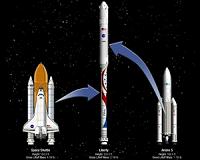
The original Project Constellation was designed to create two sets of rockets suitable for a wide range of missions, with emergency abort systems and safety measures that the space shuttle never had. The new rockets were known as Ares 1 and Ares 5 and were intended to take astronauts anywhere in our solar system. The farthest humans have travelled so far is the moon, during the Apollo Program from 1969 to 1972.
As promised, the station was finished and the shuttles were retired, but President Obama cancelled the follow-on Ares rocket programs.
Since the Ares 1 was not completed, NASA was forced to buy seats on Russia's Soyuz spacecraft to keep the ISS staffed. Meanwhile, we have been witness to four years of uncertainty regarding NASA's human space exploration plans.
Everyone interested in the space program had an opinion about how to proceed. In fact, even Neil Armstrong, the first man to walk on the moon, gave his opinion to Congress in 2010. He encouraged returning to the moon as a first step to future exploration.
It is interesting to note that the very people who threw Constellation "under the bus" in 2009 are now busy retrieving pieces of the plan, brushing them off and claiming new insights into humanity's place in the universe.
