
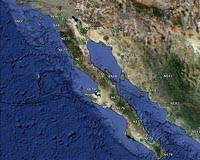
The Colorado River Delta once again features flowing water, as the river and Gulf of California, also known as the Sea of Cortez, became reconnected after 16 years of separation.
The river was reinvigorated by an experimental flood of water released earlier this spring from the Morelos Dam just south of where California, Arizona and Mexico meet. The experiment, called a "pulse flow," slowly sent water traveling down more 100 miles of barren delta.
The dam release came after many years of lobbying by environmental groups. The dried-up delta has seen inconsistent water flow for the last 50 years. Conservationists hope the Colorado River's reconnection with the Sea of Cortez will spur new tree growth, restore habitat, and encourage birds and other wildlife to return to area.
"I think it's more important to us as human beings and our sense of what is right for our river, then it is in terms of a particular ecological goal that I could express to you," Jennifer Pitt, of the Environmental Defense Fund, told local radio station KJZZ.
Much of the West, including Arizona, California, Colorado, Nevada, New Mexico, Utah and Wyoming, is heavily reliant on the Colorado for its drinking water. But so are the Mexican states of Baja California and Sonora — states that have seen very little of a once mighty river.
The latest pulse flow, at least momentarily, has altered that reality. Yesterday, children in San Luis Rio Colorado, a small town of Sonora, could be seen frolicking in the returning water.
"Maybe the more immediate impact was the story of the communities coming back to their river which had been missing for so long, and kids coming to see the river that they have never seen before," Pitt added.
Stranded ship in Galapagos Islands an environmental 'emergency,' Ecuador says
Baquerizo Moreno, Ecuador (UPI) May 16, 2013 –
Officials in Ecuador have declared an emergency, as a large cargo ship that ran aground last week remains idled in the Galapagos Islands — a threat to the region's fragile ecosystem.
Last Friday, the freighter, Galapaface I, miscalculated and ran out of deep water, colliding with the rocky coast of San Cristobal Island. The ship was carrying more than 15,400 gallons of diesel fuel and several tons of cargo. While most of the oil and cargo has been removed, the ship is still full of other pollutants, like motor oil, that officials worry could leak into the water as the freighter continues to sink.
"The ship is stranded and continues to present an environmental risk for the Galapagos Marine Reserve and must leave the area," Governor Jorge Torres told the Efe news agency.
A press statement released by Ecuador officials confirmed that the emergency, which will grant additional funding to clean up efforts, will remain in place for six months.
In 2001, an oil tanker wrecked and spilled 800,000 gallons of fuel into the ocean. The pollution proved fatal to many marine iguanas in the area.
The Galapagos are a World Heritage Site, protected for their unique species and biodiversity. The islands were made famous by Charles Darwin who visited them in 1835 and studied the brids and reptiles, which helped inspire his theory of evolution and his groundbreaking book On the Origin of Species.
