
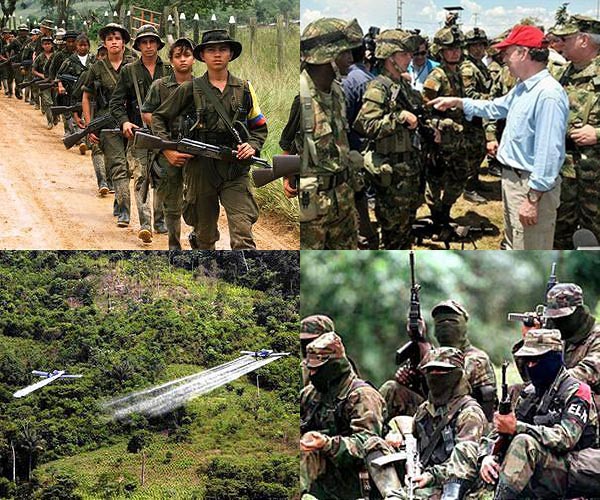
Colombia is to deploy 400 soldiers to fight drug traffickers operating across its rural southern borders, after a recent spike in killings and internal displacement, the South American country's government said Monday.
There will be six sectors along Colombia's borders with Ecuador, Peru and Brazil, "with 400 soldiers and officers who will be on the front line of operations… to block the drug trafficking corridors," Interior Minister Alfonso Prada told reporters after a security cabinet meeting.
President Gustavo Petro, the country's first left-wing president, had called the meeting with senior military officers after recent fighting between armed groups left 18 dead and displaced a dozen families in the southwestern region of Putumayo, bordering Ecuador and Peru.
Those clashes pitted a dissident faction of the FARC guerrillas — the "Carolina Ramirez" front — against another armed group, the "Comandos de la Frontera."
The "Carolina Ramirez" front belongs to the largest faction that withdrew from the peace pact that disarmed the FARC in 2017, according to local media.
According to the government, these two groups are fighting for control of drug trafficking routes in the forests between Colombia and Ecuador.
"We have contacted neighboring countries because we have seen an activity that we are going to fight with our army, but also with international cooperation", said Prada.
He specified that the Colombian government had also spoken with authorities in Panama and Venezuela, where the powerful Colombian drug cartel, the Gulf Cartel, and the Colombian guerrillas of the rebel National Liberation Army (ELN) operate respectively.
The ELN, considered the last active guerrilla movement in the country, resumed peace talks with the Petro government in Caracas on November 21.
During his inaugural speech in August, Petro declared that it was "time to have a new international convention which accepts that the war against drugs has failed," and to favor a "strong policy of prevention of consumption" in developed countries.
Colombian victims' families see FARC sentences as too lenient
Bogota (AFP) Nov 28, 2022 –
Representatives of victims killed in Colombia's decades-long conflict on Monday rejected planned sentences that would see FARC commanders avoid jail time.
A special peace tribunal said last week that six former FARC commanders may receive eight-year sentences "of non-carceral restriction of freedoms and rights."
Colombia's Special Jurisdiction of Peace (JEP) was set up to try the worst crimes committed during the conflict after a 2016 peace deal between the government and the once-powerful insurgent group.
"The victims feel disillusioned, so we have decided to withdraw. We will not find justice with the JEP," said the Foundation for the Defense of the Innocent, which represents some families of a group of 12 legislators who were kidnapped by FARC in April 2002.
The guerrilla group executed 11 of them in 2007 after years of captivity.
Some nine million people were killed, injured, kidnapped or displaced during the decades of conflict with the FARC.
The tribunal has yet to sentence the six commanders, who are accused of more than 21,000 kidnappings and other crimes committed between 1990 and 2016.
However, under the peace deal, it can offer alternatives to jail time to people who confess their crimes and make reparations to victims.
In June, the commanders admitted their "individual and collective responsibility" for the "abominable" crimes committed by their organization, which has since rebranded as a political party.
Franco-Colombian politician Ingrid Betancourt, who was held hostage by the group for six years before being rescued in 2008, said in a press release she would appeal what she dismissed as a "symbolic punishment."
Similarly, retired police general Luis Mendieta, who was held hostage by the rebels for 12 years, told local radio that the former guerrillas "did not respect the truth" and that the JEP has "no interest in administering justice."
The JEP has also charged 19 soldiers with war crimes and crimes against humanity for murdering 303 people, mostly civilians, who they pretended were rebels, to show they were making headway in the fight against the rebels.
