
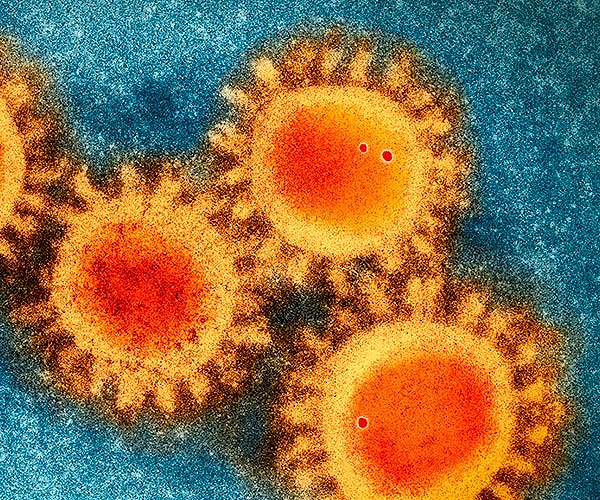
A person on a poorly ventilated Chinese bus infected nearly two dozen other passengers with coronavirus even though many weren't sitting close by, according to research published on Tuesday that offers fresh evidence the disease can spread in the air.
Health authorities had initially discounted the possibility that simply breathing could send infectious micro-droplets into the air, but did a U-turn as experts piled on pressure and evidence mounted.
The article published Tuesday in JAMA Internal Medicine probes the threat of airborne infection by taking a close look at passengers who made a 50-minute trip to a Buddhist event in the eastern Chinese city of Ningbo aboard two buses in January before face masks became routine against the virus.
Researchers believe a passenger, whose gender was not identified, was likely patient zero because the person had been in contact with people from Wuhan, the city where the contagion emerged late last year.
The scientists managed to map out where the other passengers sat, and also test them for the virus, with 23 of 68 passengers subsequently confirmed as infected on the same bus.
What is notable is that the sickness infected people in the front and back of the bus, outside the perimeter of 1-2 meters (three-six feet) that authorities and experts say infectious droplets can travel.
On top of that, the sick passenger was not yet showing symptoms of the disease, such as a cough, when the group made their trip to a religious event.
Researchers also noted the air conditioning simply recirculated the air inside the bus, which likely contributed to spreading of the virus.
"The investigations suggest that, in closed environments with air recirculation, SARS-CoV-2 is a highly transmissible pathogen," they wrote, referring to the name of the virus.
"Our finding of potential airborne transmission has important public health significance."
Their study, which includes a diagram showing where each infected passenger sat, adds to the evidence of airborne transmission, including research into how the virus spread between diners' tables at a restaurant in the southern Chinese city of Guangzhou.
Wuhan, Ground Zero for coronavirus epidemic, re-opens all schools
Beijing (AFP) Sept 1, 2020 –
Students in face masks returned to class Tuesday in Wuhan, the central Chinese city where the coronavirus first emerged last year, as the city opened schools and kindergartens for the first time in seven months.
Nearly 1.4 million students resumed classes at some 2,800 kindergartens, primary and middle schools across the city, following the re-opening of high schools in May.
State media broadcast images of thousands of students hoisting the Chinese flag — a daily routine at all public schools — despite warnings to avoid mass gatherings.
Schools have drawn up plans to switch back to online teaching should new outbreaks emerge, city officials said last week.
Students were advised to wear masks to and from school and avoid public buses or trains if possible.
Schools were also ordered to conduct drills and training sessions to help prepare for new outbreaks.
Official figures show Wuhan accounted for 80 percent of China's more than 4,600 coronavirus-related deaths and was under a strict lockdown for more than two months from late January.
The city also conducted a mass testing campaign targeting ll million residents in May.
China has now largely controlled the spread of the virus, and schools across the country — which were closed in late January — have gradually re-opened.
Shanghai re-opened schools in May, and the capital city Beijing, which recently suffered from a local outbreak of the virus, said it will resume all schools including kindergartens in September.
Beijing authorities require teachers and students to wear face masks on campus.
China has not reported any new local transmissions of the coronavirus in recent days.
