
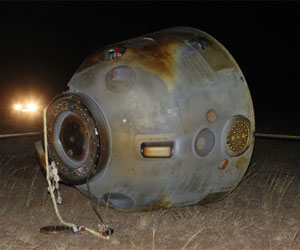
China's unmanned spacecraft Shenzhou VIII returned to Earth on Thursday, state media reported, after completing two space dockings that have pushed forward the nation's ambitious space programme.
The vessel's re-entry module landed in the northern region of Inner Mongolia after it separated from its orbital and propelling modules just before entering Earth's atmosphere, the official Xinhua news agency said.
Shenzhou VIII, which means "divine vessel" in Chinese, took off from northwest China on November 1, and docked with the Tiangong-1 experimental module twice in the nation's first ever "kiss" in space.
The successful manoeuvre is key to China's ambition to set up a manned space station by 2020 — a goal that requires it to perfect docking technology.
The technique is hard to master because the two vessels, placed in the same orbit and revolving around the Earth at thousands of kilometres per hour, must come together very gently to avoid destroying each other.
China sees its space programme as a symbol of its global stature, growing technical expertise, and the Communist Party's success in turning around the fortunes of the once poverty-stricken nation.
China is expected to launch two more spacecraft next year to dock with Tiangong-1 — the Shenzhou IX and Shenzhou X — at least one of which will carry astronauts on board.
China completes second space docking
Beijing (AFP) Nov 14, 2011 –
China completed its second space docking on Monday, state media reported, as it moves closer towards fulfilling its ambition to set up a manned space station.
The move comes 12 days after the Asian nation successfully completed its first ever "kiss" in space, when the Shenzhou VIII spacecraft joined onto the Tiangong-1 experimental module 343 kilometres (213 miles) above the Earth.
The two unmanned vehicles had been travelling together since the successful maneouvre on November 3, and on Monday, Shenzhou VIII disengaged from Tiangong-1 for half an hour before re-docking with the module, the state Xinhua news agency said.
The Shenzhou vehicle, whose name translates as "divine vessel", is a modified version of the capsules that took the first Chinese astronauts into space as part of the rising power's ambitious exploration programme.
China aims to complete construction of a space station by 2020, a goal that requires it to perfect docking technology — a delicate manoeuvre that the Russians and Americans successfully completed in the 1960s.
The technique is hard to master because the two vessels, placed in the same orbit and revolving around the Earth at thousands of kilometres per hour, must come together very gently to avoid destroying each other.
Shenzhou VIII took off on November 1 from the Jiuquan base in the northwestern province of Gansu, from where Tiangong-1 — or "Heavenly Palace" — also launched on September 29.
It is set to return to Earth on Thursday, Wu Ping, spokeswoman for China's manned space programme, told reporters earlier.
China sees its space programme as a symbol of its global stature, growing technical expertise, and the Communist Party's success in turning around the fortunes of the once poverty-stricken nation.
If the current mission is a success, China will launch two more spacecraft next year to dock with Tiangong-1 — the Shenzhou IX and Shenzhou X — at least one of which will be manned.
