
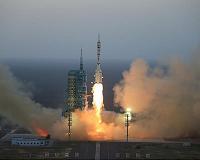
China's solid-fueled carrier rocket Kuaizhou-1A (KZ-1A) put in space on Monday three satellites as part of its first commercial launch, Xinhua news agency reported.
The carrier rocket with JL-1, CubeSatsXY-S1 and Caton-1 satellites was launched from northwestern China's Jiuquan Satellite Launch Center at around 12:11 p.m. local time (04:11 GMT).
The JL-1 satellite was developed to provide high-definition video images, which can be used for different purposes, including for forestry surveying and environmental protection, according to the media outlet.
Two other experimental satellites were designed to test technologies of low-orbit narrow-band communication and very high frequency Data Exchange System (VDES).
The China Aerospace Science and Industry Corporation (CASIC) was responsible for the space mission.
The KZ-1A carrier rocket was developed to launch low-orbit satellites weighing under 0.3 metric tons.
China to Carry Out Some 30 Space Launches in 2017
China plans to carry out some 30 space launches in 2017, local media said Tuesday.
The launches include the Chang'e 5 unmanned lunar exploration mission atop a Long March 5 lift vehicle due to take place in late 2017, the China News Service agency reported, citing the China Aerospace Science and Technology Corporation (CASC).
The mission is set to be China's first to return with lunar soil samples. China also plans to launch a Tianzhou automated cargo spacecraft atop a Long March 7 rocket to supply the Tiangong-2 space laboratory, which was launched in late 2016.
The Tiangong 2 space laboratory is designed to probe life support technologies for Beijing's future space station and is manned by a crew of two. The Long March 7 is due to be launched in April.
