
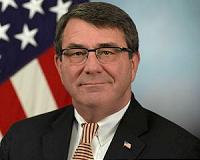
China's efforts to reclaim land in the South China Sea and build up its navy are increasingly spurring regional neighbors to oppose Beijing, US Defense Secretary Ashton Carter said Thursday.
"Chinese behavior is having the effect of self-isolation, and it's also galvanizing others to take action against it," Carter told lawmakers on the House Appropriations Committee.
China's claims to almost all of the South China Sea are widely disputed and the body of water has long been viewed as a potential flashpoint.
China is using dredgers to turn reefs and low-lying features into larger land masses for runways and other military uses to bolster its claims of sovereignty in the region.
Carter said other nations in the region are responding by stepping up their own maritime defense activities and aligning themselves with the United States.
"Old allies, like Japan, South Korea, Australia and the Philippines, and then new partners, like Vietnam and India, that are working with us increasingly," he said.
Carter's comments came shortly before Admiral Harry Harris, the commander of the US Pacific Command, was due to brief Pentagon reporters about China's naval activities.
Harris warned lawmakers this week that China is "clearly militarizing" the South China Sea and said the United States would increase its "freedom of navigation" operations — in which a US warship sails within 12 nautical miles of islets claimed by China — as a way of rebutting its assertions of sovereignty.
Satellite imagery released this week shows China is installing radar facilities on its artificial islands.
China has also deployed surface-to-air missiles and lengthened a runway to accommodate fighter jets on one such islet, Woody Island.
China claims South China Sea defences 'absolutely necessary'
Beijing (AFP) Feb 25, 2016 –
China's defences in the South China Sea are "absolutely necessary", Beijing said Thursday, as it accused the US of militarising the region.
The defence ministry spoke out as tensions rose between the two powers over reports that Beijing has deployed surface-to-air missiles, fighter jets, and radar installations in the contested region.
"The US is truly the one pushing militarisation in the South China Sea," said ministry spokesman Wu Qian at a regular monthly briefing.
"China's building of defence facilities on the South China Sea islands and reefs is absolutely necessary."
Beijing claims almost the whole of the South China Sea — through which a third of the world's oil passes — while several other littoral states have competing claims, as does Taiwan.
"It is China's legitimate right to deploy defence facilities within its own territory — no matter whether that deployment was in the past or at the present, no matter whether for a temporary or long-term basis, and no matter what kind of equipment has been deployed."
A US official told AFP that Beijing has deployed surface-to-air missiles on Woody Island in the disputed Paracels chain — apparently HQ-9s, which have a range of about 200 kilometres (125 miles).
Citing two unnamed US officials, American broadcaster Fox News said Tuesday that US intelligence services had spotted Chinese Shenyang J-11 and Xian JH-7 warplanes on the same island.
Reports also surfaced this week of probable radar installations on reefs in the nearby Spratly islands that would "exponentially improve" the country's monitoring capacities.
The United States has in recent months sent warships to sail within 12 nautical miles — the usual territorial limit around natural land — of a disputed island and reef transformed into an artificial island in what it says is a defence of the right to free passage.
Chinese foreign minister Wang Yi on Thursday concluded a visit to the US for talks with US secretary of state John Kerry, who told reporters last week: "There is every evidence, every day, that there has been an increase of militarisation of one kind or another. It's of a serious concern."
