
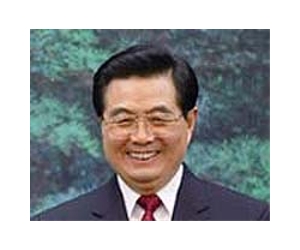
Chinese President Hu Jintao told US President Barack Obama Thursday that Beijing has an "unswerving" resolve to pursue currency reform, but needs a sound world economy to do it, an official said.
"President Hu also stressed that China's resolve to push forward foreign exchange reform is unswerving," foreign ministry spokesman Ma Zhaoxu said after Hu and Obama met just prior to the start of a G20 summit in Seoul.
"The reform will need a very sound external environment and can only be implemented in an incremental process," Ma told reporters, throwing the onus on the United States to avoid any instability in the world economy.
According to Chinese television news, Hu also told Obama that Beijing was "paying attention to the quantitative easing policy" — a 600-billion-dollar stimulus by the Federal Reserve that has sparked worldwide concern.
"US policies should take into account the interests of emerging market countries and developing countries," Hu said, according to the bulletin on state TV.
US officials said the 80-minute bilateral meeting was dominated by divisions over exchange rate policy and the need to improve the atmosphere of the broader Sino-US relationship ahead of a visit by Hu to Washington in January.
Washington has become increasingly impatient with China's so-far limited efforts to allow the value of its currency to rise. US officials say the yuan's value is kept artificially low to boost Chinese exports.
But Beijing has hit back by leading global criticism of the Fed's renewal of quantitative easing, arguing Washington is risking the global recovery in its own search for growth by flooding vulnerable emerging economies with new money.
The argument has roiled the G20 summit, with Beijing pushing for the group to monitor policy shifts by the US central bank, and the United States wanting action to trim the bloated trade surpluses of exporters such as China.
But in a brief photo-op that was open to reporters, Hu told Obama that China was ready to work with Washington to "increase dialogue, exchanges and cooperation", and said he hoped his US visit would be a success.
After the meeting, commerce ministry spokesman Yu Jianhua said Beijing was not seeking to confront the United States on economic matters.
"I don't think we want to carry out confrontation with the United States, whether on currency or trade," he said, adding there was much "common ground" to be found between the world's two largest economies.
earlier related report
Moody's boosts China ratings on 'resilient' economy
Beijing (AFP) Nov 11, 2010 –
Moody's on Thursday upgraded China's government bond ratings to "Aa3" from "A1" based on the country's "resilient" economic performance and prospects for continued strong growth.
The international ratings agency said it was maintaining a positive outlook amid expectations that the world's second-largest economy would remain stable over the medium term.
"The record of the past year demonstrates that China's policy response to the 2008 crisis has been effective," Moody's senior vice president Tom Byrne said in a statement.
"In particular, we premised our action on the ability of the Chinese authorities to protect systemic stability from the underlying threats arising from the extraordinary credit expansion evident in 2009."
Moody's said China's four-trillion-yuan (600-billion-dollar) stimulus plan unveiled during the crisis had "only modestly affected government finances" and the budget deficit was likely to be contained within three percent of GDP this year and next.
Potential losses from a credit surge in 2009 and sharp rises in local government financing are likely to be manageable and China's large pool of national savings has bolstered the government's financial strength, it said.
China's strong external payments position, backed by the world's largest foreign exchange reserve of 2.65 trillion dollars as of the end of September, provide a substantial buffer to global financial market turbulence, it said.
Beijing's capital controls will also help stem speculative cash inflows, it added.
"Only a handful of highly-rated advanced industrial economies such as Norway, Switzerland, Japan, Hong Kong and Singapore have a stronger international investment position than China," the agency said.
The agency forecast China's economic growth to ease to a more sustainable rate — at around nine to 10 percent this year, and eight to nine percent in 2011.
Moody's said China's largest banks had not been "materially damaged by the global crisis", despite fears that a portion of the 9.6 trillion yuan in loans granted last year could go bad.
It noted that external risks to trade relations may be the most threatening over the near term, including tensions with key trading partners over the value of the yuan.
Separately, the agency upgraded the long-term ratings of three major policy banks — China Development Bank, Export-Import Bank of China and Agricultural Development Bank of China — to Aa3 from A1, with a positive outlook.
Share This Article With Planet Earth
