
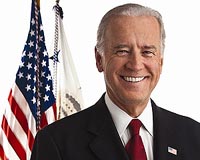
China must abide by the same international rules as everyone else, US Vice President Joe Biden warned after a UN-backed tribunal ruled against Beijing's claims in the South China Sea.
The United States has no claims of its own within the vast area, but insists that all shipping has a right to pass through seas it regards as international waters.
It has previously deployed aircraft carriers and a host of other vessels to assert freedom of navigation in the South China Sea, through which a third of the global oil trade passes.
"We expect China to play by the same rules as everyone else," Biden told the Sydney Morning Herald in comments published Saturday, referring to the international rules-based system that governs claims to maritime territory.
He added that "we're urging both China and the Philippines to abide by the ruling".
Beijing asserts sovereignty over almost all of the strategically vital South China Sea, despite rival claims from its Southeast Asian neighbours, most notably Manila, a US ally which took the case to the tribunal.
China's claims, which include waters approaching neighbouring countries, are based on a vaguely defined "nine-dash-line" found on a 1940s Chinese map.
This week the Permanent Court of Arbitration in The Hague ruled China has no historic rights to resources within the area, a decision Beijing angrily rejected.
Biden, who arrives in Australia later Saturday for a visit in which he is expected to address Washington's military alliance with Canberra, said it was vital that freedom of navigation was maintained.
He said the US was working "with Australia, and countries throughout the region, to insist that the liberal international order be maintained as it relates to sustaining the free flow of commerce — keeping sea lanes open and the skies free for navigation".
A US State Department spokesman earlier in the week described the UN ruling as "final and legally binding", while Australian Foreign Minister Julie Bishop said Beijing risked reputational harm if it ignored the decision.
EU urges 'peaceful' resolution to South China Sea row
Brussels (AFP) July 15, 2016 –
The EU urged China and the Philippines to settle peacefully their dispute over the South China Sea but stopped short of pushing Beijing to abide by an international tribunal's ruling against Beijing's claims.
The watered-down statement, which came after days of arguments among member states, did not follow the lead of the United States in specifically calling on China to honour the decision by the UN-backed tribunal in The Hague.
EU foreign policy chief Federica Mogherini said in a statement that the bloc's member states "acknowledge" the ruling but said the EU does not take a position on sovereignty rows.
She added that the union "expresses the need for the parties to the dispute to resolve it through peaceful means, to clarify their claims and pursue them in respect and in accordance with international law."
"The EU calls upon the parties concerned to address remaining and further related issues through negotiations and other peaceful means and refrain from activities likely to raise tensions," Mogherini said.
The statement came after days of wrangling over wording as eastern EU countries, including Slovenia and Croatia which also have territorial disputes before the tribunal, diplomats said.
"Two member states (Croatia, Slovenia) have a principle problem with arbitration judgements," an EU diplomat told journalists on condition of anonymity.
"It is a difficult balancing act. We have a legal position, but on the other hand we need China for a whole bunch of other topics," the diplomat said before the statement was agreed.
China asserts sovereignty over almost all of the strategically vital waters, despite rival claims from its Southeast Asian neighbors, most notably the Philippines.
China's claims, which include waters approaching neighboring countries, are based on a vaguely defined "nine-dash-line" found on a 1940s Chinese map.
The row has embroiled the United States, which has deployed aircraft carriers and a host of other vessels to assert freedom of navigation in the waters — through which a third of the global oil trade passes.
The US put itself on a collision course with China on Tuesday when it described the ruling as "final and legally binding".
