
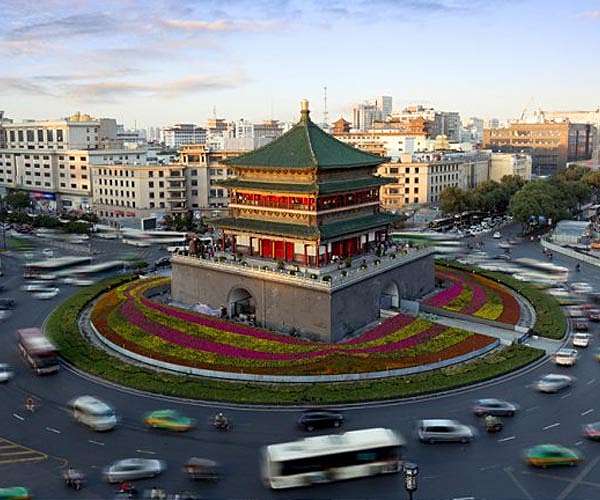
One of China's longest coronavirus lockdowns ended Monday with authorities announcing the lifting of most restrictions in the northern city of Xi'an.
The historic city's 13 million residents had been confined to their homes since December 22 after the discovery of a Covid-19 cluster that grew to more than 2,100 cases — China's largest outbreak in months.
With the Winter Olympics beginning next week, Chinese authorities have been scrambling to eradicate flare-ups in several major cities, most recently Beijing, where more than 40 cases have been recorded since mid-January.
While China's coronavirus caseload pales in comparison to global numbers, the country's strict "zero-Covid" strategy means even the slightest hint of the virus is met with contact tracing, targeted lockdowns and long quarantines.
Officials began removing Xi'an restrictions last week after daily cases slowed to single digits.
Residents with a clean bill of health are now permitted to leave the city, while public transport and economic activity have fully resumed now that Xi'an has been deemed a "low-risk" area, virus control authorities said in a statement Monday.
But travellers to Xi'an, home of the famed Terracotta Warriors, still need to provide a negative test result, while those from virus-affected areas of China are barred entry.
Xi'an authorities came under fire for their handling of the prolonged lockdown, which saw food supply issues and medical tragedies stemming from patients being denied hospital access.
– Beijing outbreak –
In Beijing, authorities are ramping up already-strict virus controls after a recent spike in cases, which coincides with the traditional nationwide travel rush before the Lunar New Year.
People in the capital who buy over-the-counter fever medication are now required to undergo virus testing, while all two million residents of one district were screened on Sunday after a local Delta outbreak involving frozen food workers was found.
Authorities said Monday they would launch a second round of testing in the district.
Meanwhile, Shanghai official Wu Jinglei told Chinese media that residents should avoid leaving the city unless absolutely necessary, after reporting a fresh locally transmitted case on Monday.
Authorities have suggested Beijing's Omicron outbreak may have originated from contaminated international mail, though experts said there was little evidence to support the idea.
Chinese customs authorities will step up testing of imported refrigerated food — which has also been blamed for carrying the virus into the country — and impose curbs including "suspension of their import business" on companies that bring in Covid-positive cargo, the official Xinhua news agency reported Monday.
Leaders are anxious to avoid a full-scale lockdown of the capital ahead of a Winter Olympics they are determined to pull off smoothly, urging residents to stay put during the Lunar New Year holiday.
Thousands of athletes, media workers and foreign dignitaries arriving for the Olympics will operate in a "closed-loop" bubble strictly cut off from the outside world. On Sunday, it was announced that more than 70 Games participants had tested positive inside the bubble so far.
The International Olympic Committee said Monday that Beijing organisers were easing their Covid test standards, allowing more athletes to avoid a positive result and continue participating in the Games despite having trace amounts of the virus in their bodies.
China on Monday reported 18 domestic transmissions, six in Beijing.
Clashes as tens of thousands protest Covid rules in Belgium
Brussels (AFP) Jan 23, 2022 –
Police fired water cannon and tear gas Sunday at stone-throwing protesters after tens of thousands of demonstrators marched through Brussels against Covid-19 rules.
Authorities estimated that around 50,000 people paraded through the Belgian capital — the largest in a spate of protests in the city over the past months.
Clashes broke out close to the headquarters of the European Union as police used water cannon and tear gas to push back hundreds of protesters who hurled paving stones and firecrackers.
EU foreign policy chief Josep Borrell condemned the "senseless destruction and violence" after masked attackers smashed a glass entrance at the offices of the bloc's diplomatic service.
Officers were later forced to seek shelter in a metro station as they were pelted with metal barriers.
Police said that around 70 people were arrested, including a dozen for more serious offences including throwing projectiles and damaging property.
Three officers and 12 demonstrators were hospitalised, but none were in a life-threatening condition.
"Freedom of expression is one of the foundations of our society. Everyone is free to express their opinion," Belgium's Prime Minister Alexander De Croo said in a statement.
"But our society will never accept indiscriminate violence, and even less towards our police forces. Those involved this Sunday will be prosecuted."
Brussels City mayor Philippe Close tweeted that it had been a "difficult day".
"Nothing can justify the physical attacks of which the police have been victims," he wrote.
The protest came as the Omicron wave causes infections to reach record highs across Europe.
Protesters carried signs conslamming De Croo and the Covid Safe pass required for entry into numerous venues.
Organisers including the World Wide Demonstration for Freedom and Europeans United for Freedom had called for people to come from other EU states.
Flags from Poland, the Netherlands, France and Romania could be seen in the crowd.
"What has been happening since 2020 has allowed people to wake up to corruption," said Francesca Fanara, who had travelled from Lille in northern France,
"I have come to march together."
"It's a health dictatorship," said Adolfo Barbosa from Portugal.
"It warms the heart to see these people here."
Belgium has seen daily infections surge to over 60,000 in the past week in what authorities have called a "tsunami".
But the milder variant and high rate of vaccination — including people getting a third booster jab — means that health systems have not come under the same strain as during earlier waves.
De Croo on Friday announced that restaurants and bars could extend their opening hours — although nightclubs still remain closed.
Neighbouring France has said it will begin a gradual lifting of Covid restrictions from February 2 after authorities said there were "encouraging signs" that the wave of infections due to the Omicron variant was ebbing.
