
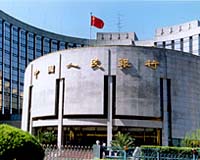
China's bank loans plunged in February from January, the central bank said, despite government efforts to encourage lending to keep the world's second-largest economy from slowing.
New loans extended by banks slid to 726.6 billion yuan ($112 billion), the People's Bank of China said late Friday, a massive drop from January's record 2.51 trillion yuan lending surge.
The figure was far below the 1.2 trillion yuan median forecast for new loans in a Bloomberg News survey and analysts.
Observers cited a drop in housing loans and a jump in lending before the early Lunar New Year holiday as reasons for the drop, though the figures were still far weaker than expected.
"China's credit expansion slowed significantly in February, even after considering the Lunar New Year effect," analyst Zhao Yang of Nomura said in a note.
"Weak credit growth suggests that housing market transactions may have slowed and that corporate investment continued to soften."
He added that credit expansion may rebound in March due to seasonal factors.
The central bank's governor Zhou Xiaochuan told reporters Saturday that "unless there are major international or domestic economic or financial volatilities, (we) will keep monetary policy stable".
He added that the central bank does not "think it is necessary to take excessive monetary stimulus" to achieve the government's growth target of above 6.5 percent over the next five years.
"But if major international or domestic events emerge, we will keep monetary policy flexible," he added.
Moody's ratings agency cut its outlook on China's sovereign bonds from stable to negative earlier this month, warning of increasing government debt and further capital outflows and questioning Beijing's ability to implement economic reforms.
China's economy grew 6.9 percent last year, the slowest rate in a quarter century, which prompted the central bank at the start of the month to reduce the amount of funds banks must set aside as reserves to boost lending.
It has also cut interest rates six times since late 2014.
Analysts predict monetary loosening going forward.
"We expect central, local and policy bank bond issuances to accelerate in order to finance the new infrastructure projects," analysts from investment bank CICC said in a note.
"In the meantime, government sectors will likely leverage up further."
China growth target 'achievable' without aggressive stimulus: central banker
Beijing (AFP) March 12, 2016 –
China can achieve its growth target without aggressive monetary stimulus, central bank governor Zhou Xiaochuan said Saturday, while acknowledging numerous "difficulties and challenges" facing the world's second-largest economy.
"We will keep monetary policy stable and don't think it is necessary to take excessive monetary stimulus to achieve the (growth) target," he told reporters at a briefing on the sidelines of the National People's Congress, the Communist-controlled parliament.
The government will keep liquidity "reasonably abundant" given the slowing growth momentum of the economy, Zhou said.
"Currently we underline the downward pressures on the economy, which faces a relatively large number of difficulties and challenges," he said.
The Chinese economy grew at its slowest pace in a quarter century last year and Beijing last week cut its 2016 expansion target to 6.5-7 percent, down from "about seven percent" previously.
The global market remains concerned over the outlook of China's economy and analysts have questioned Beijing's ability to maintain growth while implementing reforms to transform the economic model to one that relies on consumption rather than government-driven investment and exports.
The central bank has cut interest rate six times since late 2014 and also reduced the amount of funds banks must set aside as reserves to boost lending.
Reflecting jitters over the prospects of the Chinese economy, the country has seen a flood of cash leaving in the past few months and its foreign exchange reserves, the world's largest, continue to decline.
Asked about the declines, Zhou said such outflows were "not strange at all" given that China enjoyed massive inflows for many years.
"There is no need at all to rush to buy US dollars," he said.
China's foreign exchange reserves dropped $28.6 billion to $3.20 trillion at the end of February from the previous month, after falling $99.5 billion in January and a record $108 billion in December.
