
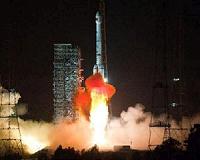
China has launched a new communication satellite from the southern province of Sichuan, local media reported Thursday.
China's Aerospace Science and Technology Corporation announced in November 2014 it was planning to launch around 120 applied satellites to update its national space infrastructure. These are planned to include 70 remote sensing, 30 navigation and 20 communication satellites.
"The 'ChinaSat 1C' satellite was launched at 12:46 a.m. [16:46 GMT] and carried by the Long March-3B carrier rocket," the Xinhua news service said.
The outlet said the launch from the Xichang Satellite Launch Center was the carrier rocket's 220th mission.
"[ChinaSat 1C] will provide high-quality voice, data and radio and TV transmission services," it added.
Earlier Report
China's indigenous SatNav performing well after tests
The three satellites launched this year for China's indigenous satellite navigation system are sending twice as many signals as their predecessors, said the system's designer, after completing tests on the new units.
The 18th and 19th satellites for the Beidou Navigation Satellite System (BDS), which is being developed as an alternative to U.S.-operated GPS, were sent into space on July 26, and the 20th on Sept. 30.
While they are less than half the weight of earlier generations, the new satellites' output is greater, matching the best around the world, said the China Academy of Space Technology in its latest newsletter.
After tests of their orbits and key technology, they are working as intended and in all weather, according to the academy.
The 18th and 19th BDS satellites are the first that can communicate with each other, helping with distance measurements, said Wang Ping, chief engineer on the project.
China began to build the BDS in 1994, two decades after the United States developed GPS. China plans to complete a constellation of 35 satellites, achieving global coverage, by 2020.
