
Moscow (Voice of Russia) Oct 18, 2013
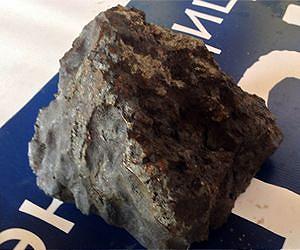
A giant fragment of the Chelyabinsk meteorite was lifted from the bottom of Lake Chebarkul near the city of Chelyabinsk in the Russian Urals Mountains on Wednesday. The fragment weighing about 570 kg proved so heavy that even the weighing machine broke, making it impossible to measure the exact weight.
Sergei Zamozdra, a professor of the Chelyabinsk State University, confirmed the meteorite nature of the rock.
"Some peculiarities characteristic of stone meteorites prove that it's a fragment of the Chelyabinsk meteorite. In all probability, it will rank among the top ten largest meteorites ever found," the scientist said.
Chelyabinsk researchers get 11-kilo fragment of Chebarkul meteorite
Chelyabinsk State University researchers have got an 11-kilo stone of what they believe is a fragment of the meteorite that pierced the ice of Lake Chebarkul in February this year. This is the 13th stone that has since been recovered from the lake bottom, according to the University website.
The Director of the University Centre for the project management of innovations and expert assessment, Andrei Kocherov, is quoted as saying in the site report that the object recovered resembles a meteorite fragment by outward signs, and weighs 11 kilos.
According to earlier reports, the biggest fragment that's been previously recovered and proved to be a part of actual meteorite weighs 4.47 kilos.
Later this Wednesday, a giant fragment of the celestial body weighing from 300 kilos to 500 kilos is due to be recovered for research.
The meteorite that later came to be known as 'Chelyabinsk Meteorite", hit the earth, specifically Lake Chebarkul in the Chelyabinsk Region, on February 15th this year. The chemical analysis of the fragments that have been recovered thus far has proved that this is ordinary LL5 chondrite, one of the types of stony meteorites.
The biggest fragment is believed to remain on the bottom of Lake Chebarkul. The expeditions that's been searching for it is due to recover an oval stone measuring 30 centimetres to 1 metre in diameter, and weighing up to 600 kilos, the RIA-Novosti news agency reports.
Chelyabinsk meteorite as old as solar system – scientists
The Chelyabinsk meteorite was as old as the solar system, deputy head of the planetary research and space chemistry department of the Russian Academy of Sciences' Institute of Geo-Chemistry and Analytical Chemistry Mikhail Marov said on Friday.
"An analysis of Chelyabinsk meteorite fragments shows that its age practically coincides with that of the solar system, 4.56 billion years. In fact, we possess a rock from the times of genesis," Marov said during the Day of Space Science hosted by the Academy Space Research Institute.
It is possible that the Chelyabinsk meteorite collided with another space body about 300 million years ago, the scientist said.
"This is just a theory, we cannot say for certain yet that this event has actually taken place," Marov said.
In the opinion of scientists, the initial mass of the Chelyabinsk meteorite was around ten tonnes at an altitude of 1,000 kilometers.
The mass was reduced to about one tonne at an altitude of 23 kilometers, when meteorite fragments exploded.
Most probably, the Chelyabinsk meteorite "is a fragment of a larger body, which continues its existence," Marov said.
Scientists attribute the Chelyabinsk meteorite to the family of Apollo asteroids.
Some 10,000 asteroids with a diameter larger than one kilometer may be cruising the solar system, and "approximately 90% of them have been discovered," Marov said.
The total mass of asteroids is estimated at 1/2000 of the Earth's mass.
A large meteorite hit the Earth's atmosphere on February 15, 2013. It exploded above Lake Chebarkul in the Chelyabinsk region, Russia.
Scientists compare Chelyabinsk meteorite with nuclear bomb
The explosion yield of the Chelyabinsk meteorite was comparable with that of a nuclear bomb, deputy head of the planetary research and space chemistry department of the Russian Academy of Sciences' Institute of Geo-Chemistry and Analytical Chemistry Mikhail Marov said on Friday.
"Actually, the speed of a meteorite's vertical drift is typical of surface nuclear explosions, which makes appropriate the comparison with a nuclear explosion," he said during the Day of Space Science hosted by the Academy Space Research Institute. Some 1,000 cubic meters of gas were emitted in the explosion and the gas mass' heating reached dozens of degrees, he said.
"That was a truly immense event," Marov stressed.
More than 1,500 people asked for medical assistance after the meteorite's shockwaves blasted through the skies over Chelyabinsk. A large meteorite hit the Earth's atmosphere on February 15, 2013.
It exploded above Lake Chebarkul in the Chelyabinsk region, Russia.
Source: Voice of Russia
