
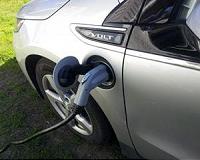
Engineers say the power grid is holding back the development of the electric car. The storage capacity of batteries are continuously improving, as are the speed at which they can be charged and discharged.
But high capacity, fast-charging batteries require large amounts of power to charge. Current infrastructure for electric car changing isn't up to the task.
To supply that charge, a team of researchers at Ecole Polytechnique Federale de Lausanne, the Swiss Federal Institute of Technology in Lausanne, have developed an intermediary power storage device. The technology can quickly charge a car without putting a drain on the power grid.
The goal is to make charging an electric car battery as quick and easy as filling up a tank with gas.
"We came up with a system of intermediate storage," Alfred Rufer, a researcher in EPFL's Industrial Electronics Lab, said in a press release. "With this buffer storage, charging stations can be disconnected from the grid while still providing a high charge level for cars."
The intermediate storage device is essentially a giant battery, a lithium iron battery the size of a shipping container. It's constantly pulling power slowly from the power grid. When it's time, it can transfer a large amount of power to the car's battery.
Right now, the device can charge the standard electric car battery in 15 minutes.
"Our aim was to get under the psychological threshold of a half hour," said Massimiliano Capezzali, deputy director of the EPFL Energy Center and leader of the research project. "But there is room for improvement."
As part of the project, researchers built models to predict the ways gas stations will need to adapt as gas-powered cars are phased out and replaced by large fleets of electric cars.
The numbers suggest a station charging 200 cars per day would require a buffer storage capacity of 2.2 megawatt hours. That corresponds with a intermediate storage device about the size of four shipping containers.
"Electric cars will change our habits. It's clear that, in the future, several types of charging systems — such as slow charging at home and ultra-fast charging for long-distance travel — will co-exist," said Capezzali.
News in briefs: Underwear-clad car owner foils theft in -17C
Oslo (AFP) Jan 20, 2016 –
A car thief in Norway got more than he bargained with when the vehicle's owner, dressed only in his underwear, clung heroically to the vehicle's roof in temperatures of -17C (one degree Fahrenheit) to foil the theft.
In a scene worthy of a Hollywood movie, the 25-year-old was woken on Tuesday night by the unwelcome sound of his car's engine starting up, police reported.
Without stopping to dress, he dashed out into the snow, grabbed the car door handle and managed to clamber onto the roof, where he clung on for several kilometres (miles) as the car travelled at up to 90 kilometres per hour (56 mph).
He then smashed the back window with his knee and grappled with the thief before the car slid into a safety barrier on a bridge and came to halt.
"Bruce Willis wouldn't have managed that," commented Jan Nesland, police chief in Randesund, a town in southern Norway where the incident took place.
"It's not what we advise people to do but now he's done it, it's really an incredible story," he told the television channel TV2.
Police are questioning the thief, who was reportedly already known to the authorities for other robberies.
The car owner, whose name has been withheld, received hospital treatment for cuts and scrapes to the knees and legs — not to mention the cold.
