
Canadian Prime Minister Stephen Harper announced Friday a series of scientific projects designed to assert Canada's claim of sovereignty over the Arctic.
"Scientific inquiry and development are absolutely essential to Canada's defense of its North, as they enhance our knowledge of, and presence in, the region," said Harper, speaking in the town of Churchill, Manitoba.
"Like I've said so many times before, use it or lose it is the first principle of sovereignty," the prime minister said.
Harper unveiled 26 more projects in line with his government's promise to earmark 150 million dollars for scientific research as part of International Polar Year.
Thousands of researchers from about 60 countries take part in studies undertaken as part of the year, which have evolved into the largest international scientific research program dedicated to polar regions.
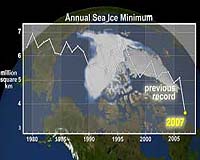
Canada is contributing to 43 of these projects. The subjects of study include how polar bears, seals and whales are adapting to climate change, the level and origin of toxic chemicals in the Arctic air, and the Arctic ice cap.
Harper also announced that Canada's federal government and the province of Manitoba will commit will spend 40 million dollars to upgrade the rail line between The Pas and Churchill.
Canada is at odds with Russia, Denmark, Norway and the United States over 1.2 million square kilometers (460,000 square miles) of Arctic seabed.
Each nation is claiming overlapping sections of the sea floor, believed to hold 25 percent of the world's undiscovered oil and gas reserves. All of them, including its allies, deny Ottawa's hold on the Northwest Passage.
In July, Harper announced plans to build six to eight Navy ice-breakers, a deep sea port in Nanisivik on Baffin Island and a military winter fighting school in Resolute Bay to firm its claim to the lonely region.
