
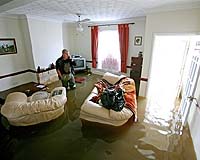
Residents in flood-hit areas of Britain breathed a sigh of relief Sunday after overnight downpours failed to riase water levels and hamper the clear-up. Meteorologists had warned that heavy rainfall in the already saturated south and west of England could trigger flash floods and worsen the crisis which has left three people dead, 300,000 residents without drinkable tap water and swamped up to 15,000 homes. But the overnight rain was not as bad as had been feared, meaning that affected communities now have a run of mostly dry days ahead to continue clearing up after the July 20 floods.
Britain's two longest rivers, the Severn and the Thames, burst their banks, leaving at least 130,000 homes without tap water after a treatment plant flooded.
Thousands of houses will get running water restoredwithin a day, but health officials warned residents the water would not be drinkable and should only be used for washing and flushing the toilet.
More than 300,000 people have been told they face up to two weeks without drinkable tap water and residents in affected towns like Tewkesbury are relying on bottled water and water tanks deployed on the streets.
Britain's Met Office national weather service said south-west England would now have a mostly dry week ahead and removed its severe weather warnings.
The Environment Agency, however, maintained three flood warnings on stretches of the River Severn aroung Gloucester, Tewkesbury and Worcester, meaning that flooding was expected to affect homes, businesses and main roads.
Communities Secretary Hazel Blears told BBC television the government would try to get emergency money quickly to those worst affected.
"What's really important for government now is that we do the clean-up but we also stay in touch with these people for months to come," she said.
"People are saying to me 'We can just about cope,' but they're worried about it happening again in the future.
"There are extra resources available. We want to get that money out to the people who are in the greatest need, people who perhaps are not insured who basically have only got what they stand up in and we've got to make sure that we get that money out as quickly as possible.
"The rain that fell was absolutely unprecedented
"I'm quite relieved, hopefully, that we're going to get a bit of respite from this weather," she added.
"The people who have been through such a terrible time in the last few weeks now have a chance, hopefully, to dry out and to recover from the devastating floods."
Four people died in the earlier June 24-25 floods which affected north and central England, where the clean-up also continues amid the wettest May to July in England and Wales since records began in 1766.
Source: Agence France-Presse
