
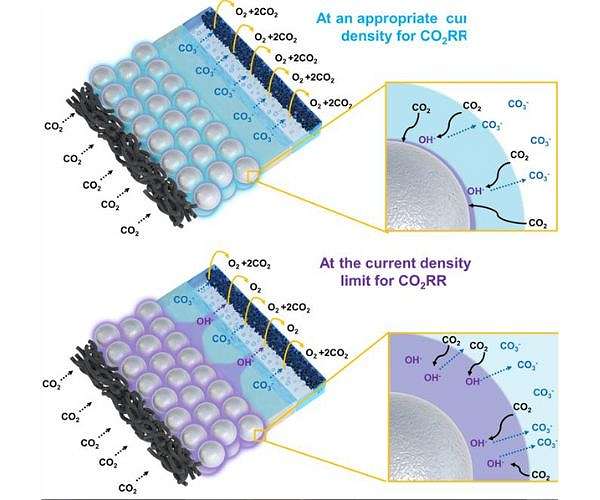
A research team at the Korea Institute of Science and Technology (KIST), led by Dr. Hyung-Suk Oh and Dr. Woong Hee Lee of the Clean Energy Research Center, has unveiled an innovative silver-silica composite catalyst for carbon capture and utilization (CCU) technology. This advancement leverages a mechanism modeled after the Earth's carbonate-silicate cycle, a critical component of the planet's natural carbon regulation system.
The Earth's inorganic carbon cycle functions by absorbing atmospheric carbon dioxide (CO2) through mineral weathering, forming carbonates that are eventually recycled as silicate rock during volcanic processes. The KIST team adapted this principle, focusing on silica's behavior during these reactions to enhance electrochemical CO2 conversion.
Traditional silver catalysts, known for efficiently converting CO2 into carbon monoxide (CO) – an essential feedstock for petrochemical processes – face significant challenges at high current densities. Issues such as particle agglomeration on the catalyst surface reduce their CO selectivity, limiting commercial use.
To overcome these limitations, the KIST researchers engineered a silver-silica composite catalyst capable of reversible pH control through a silica-hydroxide cycle. Hydroxide ions generated during reactions interact with silica, forming dissolved silicate that re-precipitates under neutral conditions, maintaining pH balance and preventing performance deterioration.
The new composite catalyst achieved nearly 100% CO selectivity even at a current density of 1 A cm. In comparison, conventional silver catalysts typically see selectivity drop to around 60% at 800 mA cm. Additionally, this approach enhanced CO2-to-CO conversion efficiency by approximately 47%, demonstrating consistent performance at high current densities without altering the catalyst's physical structure.
This advancement marks a significant step forward for CCU technology, enhancing both the durability and efficiency of electrochemical CO2 reduction processes. The team aims to refine production methods and carry out long-term stability tests, with potential applications in industrial environments such as power plants and petrochemical facilities.
"The research provides a significant direction in enhancing catalyst reversibility and environmental control strategies for electrochemical systems. It is expected to contribute to the future demonstration and commercialization of electrochemical systems," said Dr. Oh of KIST.
Research Report:Breaking the current limitation of electrochemical CO2 reduction via a silica-hydroxide cycle
