
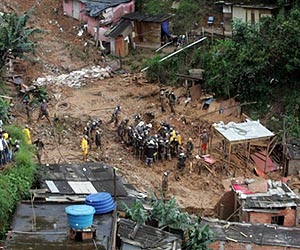
Rescuers raced against time Saturday amid fading hopes of finding survivors of a huge mudslide, with over 400 people now feared dead in some of the worst flooding to swamp Brazil in decades.
Rescuers painstakingly pulled bodies from the thick mound of dirt and debris in the Niteroi shantytown of Morro do Bumba late Friday and Saturday, bringing the death toll to 223.
Another 200 people were feared to have been buried alive in the slum, itself precariously perched atop a garbage dump in this city just east of Rio de Janeiro.
Some 60 hours after the heaviest rains in half a century unleashed floods and mudslides, rescue workers still were far from having finished the work of recovering bodies from beneath tonnes of rocks, rubble and earth.
The floods tore through the metropolitan area's precarious hillside slums, or favelas.
Niteroi was hardest hit, with at least 141 dead, according to the civil defense authorities. Across the bay, another 63 were found in Rio de Janeiro.
The heavy rain forced some 50,000 people to leave their homes, officials said, either because their homes were damaged or because they were ordered to leave due to fear of fresh landslides.
Geologist Marcelo Motta, who participated in an investigation of the mudslide, told Globo News television that two cracks in the rocky soil made the mound move and pushed down the hill a huge amount of trash saturated with water that had trapped methane gas.
Focus quickly turned on responsibility for the huge death toll and damage. Experts blamed government "complacency" for allowing the country's poorest to build housing haphazardly in areas at risk of natural disasters, such as on the sides of steep hills.
Rio state Governor Sergio Cabral, who briefly visited Morro do Bumba late Friday, laid blame on "all of society."
"I was criticized in some favelas when I got walls built to prevent them from expanding. In Rocinha, the state compensated 300 families (for relocation). But demagogues criticized us, and sometimes rabble-rousing can be deadly."
Cabral, who called for "strict measures to withdraw" from areas at risk, said he asked the Brazilian military to help in rescue efforts.
Another favela also was now reportedly at risk — Morro do Ceu (Heaven Hill) — which could soon be evacuated, local media said.
Rio Mayor Eduardo Paes has adopted a decree to remove "by force," with the help of police, people living in areas at risk.
Firefighters working at the site since Wednesday, however, said there was little chance of finding new survivors after part of the hillside fell away and swallowed everything in its path, including 50 houses, a day-care center and a pizzeria.
A handful of people were rescued from the mud in the few hours after the landslide.
Cristiane Oliveira, 27, saved her daughters from the mudslide but lost her mother, uncles and cousins and still waited to see their bodies emerge from the piles of earth.
"I look and I think, 'Everyone is under there.' It's really sad," Oliveira told AFP.
Labor Minister Carlos Lupi said a 30-year credit line of 567 million dollars, with a three-percent interest rate, was set up to seed construction of public housing.
The federal government released 113 million dollars in aid for municipalities in Rio state affected by the floods and mudslides, Cabral said.
After five days of rains, aggravated by numerous floods in the region, the sun was shining Saturday in Rio.
Share This Article With Planet Earth
