
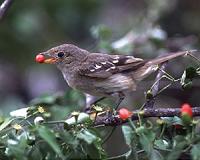
Birds with a taste for spice help spread the seeds of rare wild chili peppers, according to new research.
When a team of scientists set out to better understand the mutually beneficial relationships formed between fruit-bearing plants and fruit-eating species, they turned their attention to the wild chilis of the Mariana Islands in the North Pacific.
The donne' sali chili plant grows wild on the islands and is a favorite food of local birds. The draw for the birds is obvious — the chilis offer vital calories. But what's in it for the chili plant?
Scientists hypothesized that passage through the digestive tract might make the chili seeds more likely to germinate.
Researchers used video footage to identify the bird species that eat the most chilis. In the lab, scientists studied seeds digested by captive specimens of the same bird species.
Their analysis — detailed in the journal Ecological Applications — showed the passage through the bird's intestines helps separate the seeds from the pulp of the fruits, improving the odds of germination when it makes its way to the forest floor.
Scientists measured germination rates of seeds excreted by various bird species. They found seeds passed by starlings boasted a statistically significant germination rate boost. The chili plant's name includes the local name for the Micronesian starling, "sali."
On the island of Guam, where starlings have lost out to an invasive snake, the donne' sali chili plant is much less abundant — a reminder of the important role fruit-eaters play in seed dispersal.
"This study teaches us about a mutualism that directly benefits people and should bolster our reasons to care about conserving biodiversity," Evan Fricke, a postdoctoral research associate at Iowa State University, said in a news release. "The loss of a bird in Guam, for instance, can cascade into a negative impact for people who like to eat these spicy chilies."
Lacoste swaps its crocodile for logos of endangered species
Paris (AFP) Feb 28, 2018 –
French fashion brand Lacoste on Wednesday swapped the crocodile logo on its shirts for the first time in its history for 10 of the most endangered species on the planet.
The green Lacoste crocodile — one of the world's best-known logos — was replaced by the Sumatran tiger, the Javan rhino and the Cao Vit gibbon on the chest of its classic white polo shirts in a limited edition charity tie-in with the Save Our Species conservation group.
All but a handful were sold out within hours of going on sale for 150 euros ($183) immediately after the brand's Paris fashion week show.
The number of polo shirts put on sale was directly linked to remaining numbers of each threatened species surviving in the wild — with only 30 for vaquita porpoises and 231 for Californian condors.
Designer Felipe Oliveira Baptista also included camouflaged images of each of the endangered animals in the last 10 looks in his autumn-winter collection.
"I think it is a great thing to do, and feels very gratifying if we can do something for these animals," he told AFP.
"Lacoste is one of the 10 more recognisable logos in the world with Coca-Cola and Apple."
The Portuguese designer said he had to be careful about using the crocodile logo — which dates from 1933 — "with respect. I don't like to plaster it everywhere. Either you be very classic with it or very original, and in this case it's quite original I think."
Lacoste's crocodile logo still features on the back of the 1,775 shirts.
Oliveira Baptista said he took his inspiration for the main collection from the 50,000 trees the Lacoste family planted around their golf course at Saint-Jean-de-Luz in southwest France during World War II.
It was also a way of sparing local men from being sent to German forced labour camps, as forestry workers were exempt from conscription, he said.
The designer had Princess Diana and the English upper classes at play in mind when he began creating the collection, with some models wearing wellingtons with hunting ponchos and boonie sun hats on top of hoodies.
"I got inspired particularly by looking back at pictures of Lady Di: how she wore clothes that were high and low at the same time," he added.
"I was looking for something timeless, something that would last more than six months."
