
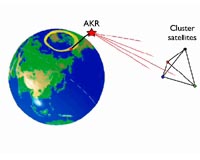
A recent study reveals how the most powerful emission of terrestrial origin, the Auroral Kilometric Radiation (AKR), is beamed into space. This result was obtained using data collected by the four satellites of the Cluster mission.
These new data were found to be inconsistent with two leading AKR beaming theories developed 30 years ago, but support a more recent one. The result has important implications for radio studies of planetary magnetospheres, including radio searches for exo-planets.
Seen from deep space, the Earth is a powerful planetary radio source, comparable to Jupiter, with maximum output power in the 50-500 kHz range. At such frequencies, the dominant emission is Auroral Kilometric Radiation (AKR), a natural electromagnetic wave generated in the auroral zones.
AKRs are intimately linked with auroras, or more precisely with the energetic electron beams that cause the
auroras. (As a reminder: it is the precipitation of such beams and their interactions with oxygen and nitrogen atoms which illuminate the sky at an altitude of about 100 km.)
Satellite observations since the 1970's have greatly enhanced our knowledge of AKR. In particular, these observations have enabled us to pin down the physical process generating this powerful emission. But even 40 years after its discovery, a fundamental problem remains: in which direction is AKR beamed with respect to the Earth's magnetic field?
Open question: How is AKR beamed in relation to Earth's magnetic field?
The question is actually more complicated than it sounds. As revealed by high-time resolution data, AKR is in fact composed of many elementary radiation sources. So far, scientists have modelled the angular beaming characteristics of AKR in a statistical sense, mainly using data collected by a single satellite.
As a result, a few beaming theories have been proposed but the only way to discriminate between them is to directly measure the angular beaming pattern of individual AKR bursts. This is what has been recently achieved thanks to data collected by the ESA/NASA Cluster mission.
The Cluster constellation consists of four satellites, each equipped with the same type of sensitive radio wave receiver – the WideBanD (WBD), built by the University of Iowa, USA, and financed by NASA. By flying in formation above AKR sources, this space fleet provides scientists with a unique opportunity to determine the angular power pattern of individual AKR bursts.
First of all, the WBD system records waves with sufficient time and frequency resolution to isolate emission from individual elementary AKR sources.
In addition, since the Cluster constellation forms a 2-dimensional array in the sky, it can simultaneously sample the burst from different viewpoints.
Finally, by measuring the differential delays between all pairs of spacecraft (6 combinations in total), the
locations of individual AKR bursts can also be determined (Mutel et al., 2003). This provides a spatial filter, which isolates radiation from a single region and allows the array to sample individual burst power patterns.
Cluster data compatible with recent model; rules out older ones
In a recent study, Dr. Robert Mutel (University of Iowa) and colleagues report the analysis of more than 12 000 individual AKR bursts collected by the Cluster mission.
"Thanks to Cluster, we could demonstrate that individual AKR bursts do not radiate in the manner described by two models that were proposed some 30 years ago. However, these new data do back up the numerical model developed 10 years ago by Louarn and Le Queau", says Mutel, lead author of this discovery which is reported in Geophysical Research Letters on 09 April 2008.
"AKR is similar to radio emissions that emanate from other magnetospheres at Jupiter, Saturn, Uranus and Neptune but also certain solar and stellar radio bursts. The radio emission is a result of a plasma instability that frequently develops in astrophysical magnetospheres which can efficiently convert free energy present in energetic particles into radiating electromagnetic waves. Its full comprehension is therefore of crucial importance", wrote Philippe Louarn (CNRS, Toulouse, France) in a recent review on the subject.
The new result clarifies how the radiation is beamed, which is in a narrow plane tangent to the magnetic field at the source, rather than a hollow cone as previously suggested.
"This has important implications for the study of AKR from other planets, stellar magnetospheres, and even the search for exo-planets by radio telescopes", notes Melvyn Goldstein, NASA Cluster project scientist.
"This result is a major scientific breakthrough obtained by the Cluster mission", says Philippe Escoubet, Cluster project scientist at the European Space Agency.
