
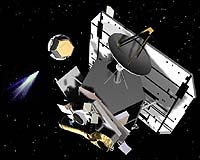
The successful Deep Impact flyby spacecraft built by Ball Aerospace and Technologies Corp., will be returned to service for two NASA Discovery assignments — the Deep Impact Extended Investigation (DIXI), and the Extrasolar Planet Observations and Characterization (EPOCh), together known as the EPOXI mission. Deep Impact successfully completed its initial mission on July 4, 2005, when the flyby spacecraft released its impactor spacecraft to create the historic encounter with Comet Tempel 1.
The flyby then maneuvered away from the comet's debris and has since been orbiting around the sun awaiting its next instructions.
"This is an extremely efficient use of the already proven Deep Impact spacecraft that will return additional scientific discoveries for a fraction of the cost of a new mission," said Cary Ludtke, Ball Aerospace vice president and general manager of the Civil and Operational Space business unit.
The DIXI mission will send the flyby spacecraft to the unexplored Comet Boethin on Dec. 5, 2008. As it passes approximately 300 miles from the comet, the spacecraft's infrared spectrometer will map the comet's surface composition, while the telescope observes surface features. While en route to Comet Boethin, the EPOCh mission will use the Deep Impact spacecraft telescope to learn more about previously discovered Jupiter-like planets orbiting nearby stars and search for evidence of Earth-sized planets.
Ball Aerospace will interface with Michael A'Hearn, EPOXI principal investigator and DIXI science team lead; L. Drake Deming, EPOXI's deputy principal investigator and EPOCh investigation lead; and the Jet Propulsion Laboratory to plan spacecraft trajectory maneuvers and science data collection and downlink to the ground. Events this year include commanding the spacecraft out of hibernation mode, a complete system health checkout, and an Earth flyby for a gravity assist to Comet Boethin.
