
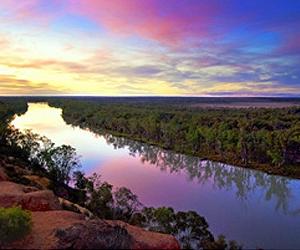
Australia's Outback soaks up 9.7 billion tons of carbon emissions and can serve as a significant carbon "bank," a new study indicates.
The area could absorb up to an additional 1.3 billion tons of carbon by 2050 through better management, states the study, "Outback Carbon — An Assessment of Carbon Storage, Sequestration and Greenhouse Gas Emissions in Remote Australia," commissioned by The Nature Conservancy and the Pew Environment Group.
That's the equivalent of taking 7.5 million cars off the road every year for the next four decades, the researchers say.
"This new and very important report shows that by taking better care of Australia's Outback, its native plants, woodlands and forests, we have a logical and inexpensive way to cut emissions right in our own backyard," said Michael Looker of The Nature Conservancy in Australia in a release.
Australia has the highest per capita of carbon emissions among developed nations.
The Outback — comprised of forests, woodlands and grasslands — covers an area of approximately 2.5 million square miles, around 80 percent of Australia's total land mass.
"Due to its enormous size, the Outback environment is able to store huge amounts of carbon, so it serves as a massive pollution bank for Australia and the planet," said Barry Traill, director of the Wild Australia Program, a joint project of The Nature Conservancy and Pew.
"However, if the wide variety of its plants and trees continue to be cleared or degraded through poor management, stored carbon will be released into the atmosphere, adding to climate pollution," he said.
The report suggests adopting measures such as reducing land clearance, controlling feral animal populations and better fire management to take advantage of the carbon "bank" potential of the Outback.
In doing so, the Outback's carbon storage levels would be significantly increased and could cut the country's greenhouse emissions by 5 percent by 2030, it says.
In most cases the changes would cost less than the estimated carbon price under the government's shelved emissions trading scheme, the report said.
The report said these changes could also increase employment. Australia's indigenous communities, for example, could implement fire-management policies such as controlled burning to prevent wildfires.
"We still need to work hard on reducing industrial emissions, we still need a carbon price, but the Outback must be a central part of any overall approach to climate change pollution," said Patrick O'Leary of the Pew Environment Group, Australian Broadcasting Corporation reports.
earlier related report
Australian Outback 'could slash carbon emissions'
Sydney (AFP) July 14, 2010 –
Australia's Outback could serve as a massive "pollution bank", cutting carbon emissions by five percent by 2030, with better land management and a cull of feral animals, environmentalists said Wednesday.
A study commissioned by the Pew Environment Group and Nature Conservancy found curbing land-clearing and wildfires, and promoting the re-growth of native vegetation, could help reduce pollution.
"Due to its enormous size, the Outback environment is able to store huge amounts of carbon, so it serves as a massive pollution bank for Australia and the planet," said project spokesman Barry Traill.
The study found that 9.7 billion tonnes of carbon is stored in Australia's central forests, grass and woodlands, and Pew spokesman Patrick O'Leary said much more could be done.
"Well over a billion tonnes can be stored between now and 2050 if we can put into practice better land management," O'Leary told public broadcaster ABC.
"This would be the equivalent of taking 7.5 million cars off the road every year for the next 40 years."
He added that culling some of the large, non-native animals released into Australia's wild, such as water buffalo and camels — which have reached plague proportions in some areas — would slash methane emissions.
"When feral animals belch they release methane, a particularly noxious greenhouse gas, and every single camel or water buffalo releases the equivalent of around one tonne of carbon dioxide each year," he said.
"When you've got hundreds of thousands, in some cases millions, of these feral animals, it's a very large amount of pollution each year."
Australia is the world's highest per capita producer of carbon emissions, and climate change is set to be a key issue in upcoming elections.
Share This Article With Planet Earth
