
The night sky has always been a source of inspiration even if we go back to the oldest civilizations that walked the earth. The cosmic beauty is still not fully explored, and we don't seem to know why ancient civilizations took so much time and effort to learn the sky.
Among the many stars and infinite galaxies, people have always made patterns that signify some things that we know from this planet. These patterns which are named after its apparent form are called constellations.
If you look up to the heavens and try to connect the dots, you'll find many constellations. Most of them are named after animals, and some signify horses. Yes, horses have been around us for thousands of years, and they are not just for racing.
Many people think about horse tournaments when they see this animal, but they carry so much significance and importance, which is why they were transformed into symbols.
Let's explore the heavens and try to find some of the horse constellations that galloped their way into the cosmos.
Horses in the Heavens
Have you ever looked up at the night sky and thought, "That cluster of stars kind of looks like a horse," Well, you are not alone. Although horses have quite complex figures and it is kind of difficult to recreate them in the night sky, there are still some star clusters that look like horses.
As we all know, ancient civilizations often used celestial patterns to connect their earthly experiences to the heavens. Horses have always been a symbol of power, freedom, and speed, and have naturally made their way into these stories.
But how many horse-inspired constellations are there, and what do they represent?
Pegasus
Pegasus is one of the most popular horses that came from a myth and made its way into a constellation. This star cluster is named after the mythical winged horse from Greek mythology.
The story is quite shady. We are talking about a horse born from the blood of Medusa when Perseus beheaded her, where he became a symbol of inspiration.
But what happens in the sky and why this star cluster is named Pegasus?
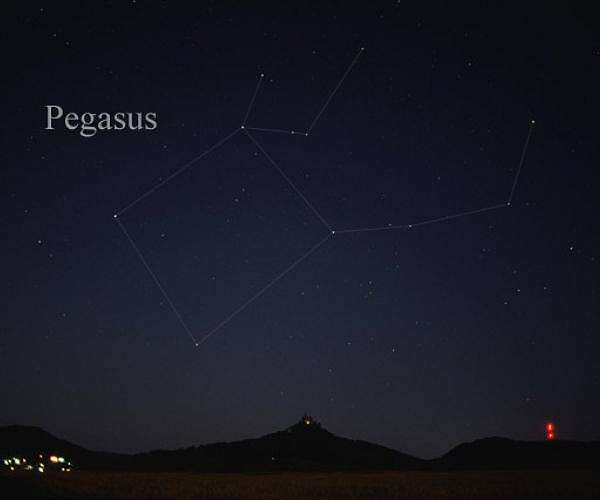
Well, the constellation of Pegasus is a celestial showcase of this legendary steed. Although the pattern doesn't look much like a horse, it is still great to carry that legendary name.
This is also one of the largest constellations in the northern sky, and it is recognizable by the Great Square (bright quartered of stars that form the body of Pegasus).
Also, this constellation is visible almost year-round in the northern hemisphere, so if you haven't already seen one, grab a telescope and take a look at this beautiful cluster of stars.
Equuleus
While Pegasus gets all the fame, his little sibling Equuleus deserves some love too. Representing a foal or colt, Equuleus is a lesser-known constellation with roots in Greek mythology. Some stories suggest it represents Celeris, a horse given to Castor, one of the famed Dioscuri twins.
Equuleus is the second-smallest constellation in the sky – so tiny, in fact, that spotting it without guidance is a challenge. Its stars are faint and less prominent, but for true equestrian enthusiasts, it's worth the effort.
Despite its modest size, Equuleus reminds us that even the smallest stars can hold big stories. Think of it as the underdog of horse constellations, quietly galloping through the cosmos.
Monoceros
Wait, unicorns? Absolutely. Monoceros, Latin for "unicorn," is another horse-adjacent constellation that has captured the imagination since the 17th century. While not as ancient as Pegasus or Equuleus, Monoceros adds a touch of whimsy to the night sky.
Unlike Pegasus and Equuleus, Monoceros doesn't come with a deep-rooted mythological tale. Instead, it emerged as a nod to the mystical unicorn, blending the earthly allure of horses with fantastical charm.
Monoceros lies along the Milky Way and is home to several star clusters and nebulae, including the Rosette Nebula and the Christmas Tree Cluster. It's a goldmine for stargazers with an eye for celestial beauty.
Did you know? Monoceros contains a binary star system (V838 Monocerotis) that expanded so dramatically in 2002 that it became one of the brightest stars for a brief period. Cosmic unicorn magic, perhaps?
The Universal Appeal of Horses in Astronomy
Why have horses found their way into the night sky? Part of it is their significance in human culture. Horses have been companions, warriors, and symbols of freedom throughout history. By immortalizing them in the stars, ancient civilizations ensured these loyal animals would never be forgotten.
Horses also symbolize journeys – both physical and metaphorical. In astronomy, they serve as reminders of humanity's quest to explore the unknown, to chase the stars, and to gallop toward new horizons.
Modern Connections
Did you know horses have inspired more than just constellations? The spirit of the horse lives on in space exploration.
For example, the Horsehead Nebula in the Orion constellation is a stunning cloud of gas and dust shaped like – you guessed it – a horse's head. Discovered in 1888, it's become one of the most iconic celestial objects for astronomers and photographers alike.
Even spacecraft have paid tribute to horses. NASA's Pegasus satellites, launched in the 1960s, were designed to study micrometeoroids in Earth's orbit. Horses, it seems, continue to gallop into the future.
Can you spot another horse figure in the heavens? Who knows, maybe you'll find a new star constellation that shares the characteristics of a horse.
