
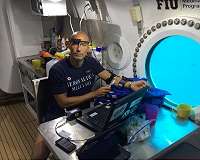
ESA astronaut Luca Parmitano has been on Earth since his mission to the International Space Station in 2013, but "Lucaparmitano" is now back in space thanks to an Italian astronomer.
The International Astronomical Union's Minor Planet Centre has confirmed a new name for an asteroid formerly known merely as 1993 TD: (37627) Lucaparmitano.
The asteroid was discovered in 1993 by Italian astronomer Vincenzo Silvano Casulli, working at the Osservatorio di Vallemare di Borbona, located in Italy's Lazio region northeast of Rome.
The prolific astronomer has discovered more than 251 objects, and says that this asteroid is likely to be around 5 km in diameter. It orbits the Sun every 3.9 years and more detailed observations should be possible from the beginning of 2018, when the asteroid will sit well away from the Sun in our skies.
Mr. Casulli feels the name is appropriate because, "Luca, who flew six months on the Space Station, didn't have his own asteroid."
The citation is simple but elegant: "Luca Parmitano (b. 1976) is an Italian engineer and astronaut in the European Astronaut Corps for the European Space Agency."
It's not visible to the naked eye, but its orbit has been confirmed by a number of observatories in the US, Europe and China.
Luca comments: "I'm still grappling with the idea that my name is connected to a celestial body. It's a wonderful gift, for which I feel honoured and humbled at the same time. I'm grateful to Mr Casulli for thinking of me.
I can't help but wonder about this asteroid, perennially travelling so far away from our world. What would it be like to stand on it? What would I see? How many sunrises and sunsets would this tiny world give me in a day? I know I will never travel there: but in a way, I'm already there.
Maybe, although invisible to the eye, 'my' asteroid will inspire people everywhere to look up, think about our presence here on our beautiful planet and work to make it a better place."
Samples brought back from asteroid reveal 'rubble pile' had a violent past
Curtin University planetary scientists have shed some light on the evolution of asteroids, which may help prevent future collisions of an incoming 'rubble pile' asteroid with Earth.
The scientists studied two incredibly small particles brought back to Earth from the asteroid Itokawa, after they were collected in 2005 from the surface of the 500 metre-wide asteroid, by the Japanese Hayabusa … read more
