
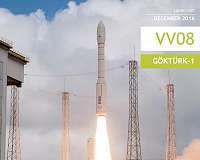
The Vega lightweight launcher continued its track record of success, lofting the Gokturk-1 Earth observation spacecraft from the Spaceport on a mission that adds another operator to those entrusting their initial payloads for launch by Arianespace.
Departing from the French Guiana launch site at the exact liftoff time of 10:51:44 a.m. local time, Vega delivered the 1,060-kg. Gokturk-1 into a Sun-synchronous orbit at an altitude of approximately 700 km.
During the initial phase of this mission – designated Flight VV08 in Arianespace's launcher family numbering system – Vega was powered by its three solid propellant stages, followed by two burns of the bi-propellant upper stage, leading to separation of Gokturk-1 at just over 57 minutes after liftoff.
Gokturk-1 is Turkey's first governmental satellite for Earth observation, designed to provide very high-resolution images for civilian and military applications. Telespazio is prime contractor for the Gokturk-1 program, working under terms of an agreement with the Turkish Undersecretariat for Defence Industries (SSM).
Thales Alenia Space and its Turkish partners – including the companies TAI A.S., Aselsan A.S., Tubitak Bilgem, Roketsan A.S. and TR Tecnoloji – built Gokturk-1 based on the PROTEUS spacecraft platform.
Flight VV08 by the numbers
Gokturk-1 was the 145th satellite from Thales Alenia Space to be launched by Arianespace, with 11 more of this spacecraft manufacturer's payloads in Arianespace's order book for future missions.
Additionally, Gokturk-1 was the 60th Earth observation spacecraft launched by Arianespace, reinforcing its ability to serve the evolving market for orbital-based imaging, observation and surveillance.
With this mission, Turkey's SSM became the 55th operator to select Arianespace for the launch of its initial satellite.
Vega's role in the Arianespace launcher family
The Flight VV08 success underscores Vega's contribution to Arianespace's launcher family, which also includes the medium-lift Soyuz and heavy-lift Ariane 5 – all operated from the Spaceport in French Guiana.
Vega was developed in a European Space Agency (ESA) program jointly funded by Italy, France, Spain, Belgium, the Netherlands, Switzerland and Sweden. Italy's Avio is design authority and industrial prime contractor for the launch vehicle, operating through its Italian subsidiary ELV (in which the Italian space agency ASI has a 30 percent stake).
The eight successful missions performed to date by Vega were for both institutional customers and commercial export customers, confirming the launcher's operational capabilities and adaptability.
Arianespace's next flight, scheduled for December, will close out another busy 12 months of launch activity. Using an Ariane 5, the upcoming mission is to deploy two telecommunications satellites into geostationary transfer orbit: Star One D1, to be operated by Brazil's Embratel Star One; and JCSAT-15, which was built for Japan's SKY Perfect JSAT Corporation.
