
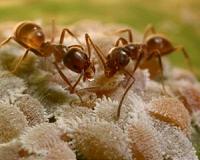
Evolution isn't relegated to large timescales; it can be measured across timespans as small as a century. New research in Cleveland, Ohio, shows acorn ants there have quickly adjusted to rising urban temperatures.
Biologists at Case Western Reserve University found the tiny ant species is less tolerant of cold temperatures, but can safely withstand the extreme temperatures that are a part of life in an urban heat island.
Scientists collected several acorn ant, Temnothorax curvispinosus, colonies from Cleveland, as well as from surrounding suburbs. The colonies were allowed to acclimate to a variety of temperatures over a period of ten weeks.
Though each colony successfully acclimated, city ants maintained their higher thermal tolerance range. The results of the tests were published this week in the Biological Journal of the Linnean Society.
"They're very plastic," Ryan Martin, an assistant professor of biology, said in a news release. "But ants collected from city habitats retained their higher heat tolerance and loss of cold tolerance compared to rural ants, regardless of whether they were born and reared under warm or cool temperatures."
Because Cleveland only became thoroughly urbanized in the last 100 years, and queen ants live between 5 and 15 years, scientists estimate their genetic response to higher temperatures happened over the course of just 20 generations.
As scientists prepare for rising global temperatures, it's vital that they gauge the ability of different species to adapt to warmer environs.
"Global data suggests that the acclimation response won't be enough to respond to climate change, but some species, like the acorn ants, may evolve quickly enough," said Sarah Diamond, assistant professor of biology.
Study sheds new light on how species extinction affects complex ecosystems
Research by the University of Southampton has found that methods used to predict the effect of species extinction on ecosystems could be producing inaccurate results. This is because current thinking assumes that when a species vanishes, its role within an environment is lost too.
However, scientists working on a new study have found that when a species, (for example a group of sea creatur … read more
