
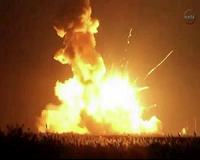
Just three weeks ago, NASA's Independent Review Team released the Executive Summary of its Orb-3 Accident Investigation Report. This report chronicles the events and summarizes the likely failure causes associated with the October 28, 2014 launch of the Orbital ATK Orb-3 cargo resupply mission to the ISS.
The Orb-3 vehicle consisted of an Antares-130 launch vehicle plus a standard Cygnus spacecraft. The payload was 2,300 kg of pressurized cargo . This was Orbital ATK's third cargo mission under its ISS CRS contract.
Just over 15 seconds into flight an explosion in the Antares Main Engine System occurred.
This event caused the vehicle to lose thrust and fall back toward the ground in close proximity to the launch pad. There was a complete loss of the vehicle and cargo. While there was some damage to the launch pad facilities, there were no injuries.
The Independent Review Team (IRT) was formed in November 2014 to determine the technical root cause of the Orb-3 failure and make recommendations leading to more reliable systems. A detailed review and analysis of telemetry, photographs and video media led to the likely conclusion that the mission failed due to an explosion in the AJ26 rocket engine installed in the Engine 1 position.
Apparently, there was an explosion in the E15 liquid oxygen turbopump, which then damaged the rocket engine installed in the Engine 2 position. Thus, both engines lost thrust and the vehicle fell back to Earth.
Although the IRT was not able to isolate a single technical root cause for the engine fire and explosion, three credible technical root causes were identified, any one, or a combination, of which could have resulted in the failure:
1.Inadequate design robustness of the AJ26 liquid oxygen turbopump Hydraulic Balance Assembly and turbine-end bearing for Antares;
2.Foreign Object Debris introduction to the liquid oxygen turbopump;
3.Manufacturing or other workmanship defect in the liquid oxygen turbopump.
In conclusion, the IRT report dictated that all three of these technical root causes need to be addressed as part of any return to flight efforts for Antares. The complete Executive Summary is available here
