
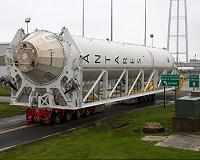
The Orbital ATK Antares launch vehicle was designed to provide services similar to the venerable Delta II, a favorite NASA launch system that is being retired. Antares is basically a two-stage vehicle with an option for a third stage.
It is primarily a low-Earth orbit (LEO) launch system with an 8,000 kg payload capacity.
The design and development were internally funded by the company and it has successfully demonstrated an ability to carry out commercial re-supply services for the International Space Station (ISS).
Orbital ATK secured a NASA Commercial Orbital Transportation Services (COTS) contract in 2013 and cargo delivery commenced under a NASA Commercial Resupply Services (CRS) contract in 2014. The vehicle has a launch history of six attempts from Wallops Flight Facility.
On April 21st, 2013 the vehicle successfully launched a Cygnus Payload Simulator. Then a Cygnus, COTS demonstration flight succeeded in September 2013. Antares carried out two successful CRS missions in January and July, 2014, but had a failure on its 3rd CRS mission almost exactly two years ago.
This event prompted a replacement for the first-stage engines from the Aerojet AJ26 to another Russian engine, the new RD-181. Antares first flight with this new engine took place successfully just one week ago.
On October 17th the vehicle lifted off from WFF at 23:45 GMT, just seconds before the five-minute launch window closed. It used Pad 0A which is operated by the Mid-Atlantic Regional Spaceport
