
An ad hoc commission investigating the July 2 crash of a Proton-M launch vehicle at the Baikonur Space Center has concluded that angular rate sensors on the rocket had been installed "upside down," Russian Federal Space Agency (Roscosmos) deputy head Alexander Lopatin said on Thursday.
"Telemetry information, an experiment on and analysis of the rocket fragments that have been found show that the manufacturer incorrectly installed the angular rate sensors," said Lopatin, who heads the investigative commission.
Roscosmos will revise the procedure of manufacturing launch vehicles and will introduce mandatory photo and video surveillance of their assembly, Lopatin said.
"We are introducing video and photo documentation of all manufacturing phases. Unfortunately, this element [the angular rate sensor] was not photographed," he said.
The sensors were installed on the rocket on November 16, 2011, he said.
Proton-M crashed due to angular rate sensor failure – Roscosmos
An ad hoc commission investigating the July 2 crash of a Proton-M launch vehicle at the Baikonur Space Center has concluded that angular rate sensors on the rocket had been installed "upside down," Russian Federal Space Agency (Roscosmos) deputy head Alexander Lopatin said.
"Telemetry information, an experiment on and analysis of the rocket fragments that have been found show that the manufacturer incorrectly installed the angular rate sensors," Lopatin said.
Decontamination of Proton rocket crash site at Baikonur completed – Kazakh space agency
The decontamination of the Proton-M launch vehicle's crash site at Russia's Baikonur space center in Kazakhstan has been completed, the Kazakh Space Agency (Kazcosmos) reported on Wednesday.
The results of the decontamination should be analyzed on July 26, it said. The collection of the rocket's debris and its removal to the space center's platform 90 is continuing, it said.
The Proton-M carrying 3 Glonass-M navigation satellites was launched from Baikonur on July 2.
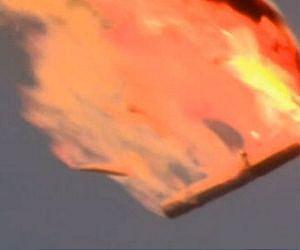
Nearly immediately after liftoff, the rocket deviated from the planned trajectory, began breaking up in midair, then fell not far from the launch site and exploded.
The rocket was fueled with about 600 tonnes of a highly toxic propellant including unsymmetrical dimethylhydrazine, amyl and kerosene.
Source: Voice of Russia
