
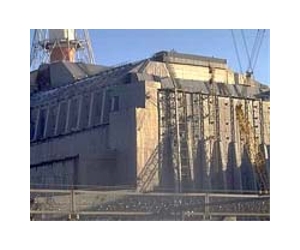
The project to build a new sarcophagus over the damaged Chernobyl nuclear reactor lacks some 600 million euros of the 1.5 billion needed, a Ukrainian official said Thursday.
"The total works are currently estimated to cost 1.54 billion euros, including 990 million for the sarcophagus itself," Volodymyr Holosha, the official in charge of the evacuated exclusion zone around the plant, told a group of journalists on a tour to the area.
Some 940 million euros had already been collected by the Chernobyl Shelter Fund, he said. "So we are missing approximately another 600 million euros ($850 million)."
Expenses in addition to the actual sarcophagus, hurriedly built to prevent radioactivity escaping after the April 1986 disaster, include decontamination of the site, and installing nuclear security systems, he said.
About 600 million euros has already been spent on works in the area.
The current sarcophagus "emits a little bit of nuclear pollution, but the quanitity is insignificant," Holosha said, adding that it could serve another 15 years after having gone through a refurbishment.
"The environmental situation in the zone of exclusion is stable and generates no worries," Holosha added.
The nuclear power station, site of the world's worst nuclear disaster, lies about 100 kilometres (60 miles) north of the capital Kiev. The fallout from its exploded forth reactor impacted most of Europe, especially Ukraine, Belarus, and Russia.
The concrete sarcophagus capping the reactor has developed cracks over the past 25 years and is not considered failsafe.
A consortium made up of French construction companies Bouygues and Vinci won a tender in 2007 to build a new sarcophagus, financed by an international foundation.
The 108-metre-high arched structure, weighing 20,000 tonnes, will be assembled close to the reactor and then slid on rails over the existing sarcophagus.
Concern over the safety of nuclear power plants has risen with the disaster at Fukushima, northeastern Japan, the worst since Chernobyl, where an earthquake followed by a tsunami led to releases of radiation way above safety limits.
Workers are battling to stabilise reactors, into which water has been poured to submerge and cool fuel rods that are assumed to have partially melted down.
They are also struggling to safely dispose of thousands of tons of highly contaminated run-off water.
Japan has considered a range of high-tech options — including covering the explosion-charred reactor buildings with fabric.
Share This Article With Planet Earth
