
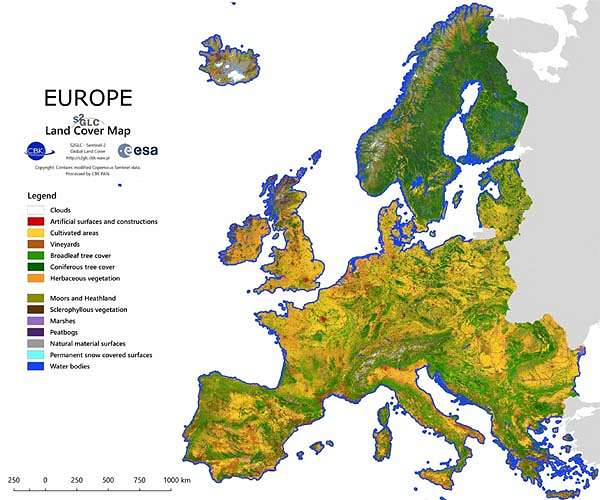
More than 80 percent of the European Union's natural habitats are in poor or bad condition and more must be done to protect them, the European Environment Agency (EEA) warned in a report Monday.
The report, which covers the period 2013-2018, shows a deterioration from the 2007-2012 period when 77 percent of natural habitats were in "unfavourable" condition.
"We clearly need a large-scale restoration in Europe," one of the authors of the report, EEA expert Carlos Romao, told reporters.
"This is a must not only for biodiversity but also for the climate change agenda," he said.
Common farmland species such as the skylark, and habitats such as wet heaths, are declining across the continent.
Habitats and species are facing numerous pressures, including intensive agriculture, urban sprawl — coupled with tourism and recreation — unsustainable forestry activities, and pollution, among others.
Climate change, with increasing drought and decreasing rainfall, also poses a challenge.
In the six-year study, the EAA registered over 67,000 types of human activities that harmed the environment in the 28 EU member states, including Britain.
Less than half of bird species in the EU, 47 percent, have a "good" conservation status, five percentage points fewer than in the previous 2007-2012 reporting period.
Habitats important to pollinators are another area of concern, as they are crucial to the planet's biodiversity. Their conservation status has deteriorated more than others, the report showed.
But the conclusions are not all dire.
The number of animal species whose conservation status was "good" was 27 percent, which, while low, was four percentage points higher than in the previous study.
And conservation efforts are paying off.
Natural habitats covered by the EU's Natura 2000 network are doing better than other habitats, the EEA said.
As a result, a number of species and habitats have improved, such as the agile frog in Sweden, coastal lagoons in France and the bearded vulture across the EU.
The areas protected by Natura 2000 covered 18 percent of EU land, unchanged from 2012, and 10 percent of marine areas, up by four percentage points.
Danish environmental group Noah, a member of the "Friends of the Earth" umbrella organisation, said however that this was not enough.
"At least 30 percent of land and 30 percent of marine areas in the EU should be protected by law, and environmental corridors should be made a part of a real trans-European nature network," it said in a study in early October.
Unusual Aussie spider builds one-of-a-kind nest with super strong silk
Washington (UPI) Oct 19, 2019 –
As far scientists know, no other spider builds a nest quite like the Australian basket-web spider.
Thanks to a new study, published Monday in the journal Scientific Reports, scientists now know how the spider's lobster pot-like web keeps its structure without the help of vegetation.
"This silk retains its rigidity, allowing a rather exquisite silken basket or deadly ant trap," study co-author Mark Elgar, a professor of evolutionary biology at the University of Melbourne, said in a news release.
For the study, researchers closely examined the chemical and structural composition of the spider's silk. Their analysis showed the silk is similar to the kind of silks used by other spiders to construct egg sacs.
"Our discovery may provide insights into the evolution of foraging webs," said Elgar. "It is widely thought that silk foraging webs, including the magnificent orb-webs, evolved from the habit of producing silk to protect egg cases. Perhaps the basket-web is an extension of the protective egg case and represents a rare contemporary example of an evolutionary ancestral process."
The lobster pot trap of the basket-web spider, found only in Australia, measures just less than a half-inch in diameter and a bit more than a half-inch in length. It features a series of cross-linked threads of varying diameters.
Researchers were able to analyze the web and its robust fibers using high-resolution imaging technologies at ANSTO's Australian Synchrotron facilities.
"Nature has created a complex structure that, at first glance, resembles industrially produced composites," said study co-author Thomas Scheibel, professor of biomaterials at the University of Bayreuth in Germany.
"Further investigations have, however, shown that they are chemically different components and their respective properties together result in the thread's extreme elasticity and toughness, thus creating a high degree of robustness," Scheibel said. "With today's composite materials, on the other hand, it is mainly the fibers embedded in the matrix that establish the particular properties required, such as high stability."
The research suggests a new genetic material is key to the robustness of the novel silk — a material that could be synthesized at scale for industrial applications.
Scientists estimate, however, that additional research is needed to isolate the material and realize its potential.
"There is increasing recognition that solutions to many of the complex challenges and puzzles we face today can be found from biological systems," Elgar said.
"This so-called 'Bioinspiration' draws on some 3.8 billion years of natural selection honing biological forms, processes and systems. The potential insights from that diversity of life, about which we still know rather little, is staggering," Elgar said.
