
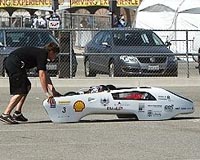
Distance, not speed, was the goal this weekend on the track at the 2009 Shell Eco-marathon Americas, a challenge for students to design, build and test fuel-efficient vehicles that travel the farthest distance using the least amount of fuel.
This year, more than 500 students from North and South America were on hand to stretch the boundaries of fuel efficiency. So who came out on top?
The student team from Laval University, with an astonishing 2,757.1 miles per gallon, equivalent to 1,172.2 kilometres per liter, won the grand prize in the "Prototype" category.
And in the "UrbanConcept" category – new to the Americas event this year – the team from Mater Dei High School took the grand prize by achieving 433.3 mpg, equivalent to 184.2 km/l.
With 44 participating teams at track competition was steep. This year's challenge brought together a number of returning teams determined to beat the 2,843 mpg (1,208 km/l) record set by Mater Dei High School (Evansville, Ind.) in 2008, combined with a number of new teams adding fresh innovation and vehicle designs to the competition.
"We knew coming into the challenge this year that we would have a lot to go up against," said David Vallee of Laval University.
"But we had confidence in our vehicle and all the hard work that had gone into building it over the past year. We're just excited the long hours paid off and we were able to win the 2009 Shell Eco-marathon Americas!"
"The Shell Eco-marathon is a platform for students to let their imaginations run wild," said Mark Singer, global project manager for the Shell Eco-marathon.
"By encouraging these students to build vehicles with greater energy efficiency, we hope this will help inspire others; and together we can find solutions that will help meet the global energy challenge."
This year, student teams were invited to participate in either the Prototype or UrbanConcept categories. For the Prototype category, teams entered futuristic prototypes – streamlined vehicles focused on maximizing fuel efficiency through innovative design elements, such as drag reduction. For the UrbanConcept category, teams entered more "roadworthy" fuel-efficient vehicles.
Aimed at meeting the real-life needs of drivers, these vehicles are closer in appearance to the cars seen on roads today. For both categories, teams could use any conventionally available energy source – including fuels such as diesel, gasoline and liquid petroleum gas (LPG), as well as alternative fuels such as hydrogen, biomass and solar.
The 2009 Shell Eco-marathon Americas roster contained 44 teams from six high schools and 29 universities from North and South America, including Brazil, Canada, Mexico and the United States. Additionally, a guest team from India joined the roster with their Prototype vehicle.
The Prototype entries included 28 vehicles powered by combustion engines, five by fuel cell/hydrogen technology, three by LPG, three by solar power, and two by diesel fuel. The UrbanConcept entries included two vehicles powered by combustion engines and one by solar power.
Eco-Design Award
A special "Eco-Design Award" was presented to the UCLA team for their Prototype design. Their special design not only contributed to the fuel efficiency of their vehicle, but incorporated recycled and eco-friendly materials into the vehicle and production process.
Safety
The "Safety Award" recognized three teams who made the most extensive efforts to comply with the safety regulations of the Shell Eco-marathon Americas. This award went to UNAM (Universidad Nacional Autonoma de Mexico), Grand Rapids Technical School and Loyola Marymount University. These teams all demonstrated safety as a top priority in vehicle designs and construction.
Technical Innovation
This award was presented to three teams who demonstrated outstanding initiative and technical ingenuity along with optimal use of new materials in the drive train, chassis, instrumentation and tires. First prize was awarded to Rose-Hulman Institute of Technology, second prize to Purdue University and third prize to California Polytechnic State University.
Design
The 2009 Shell Eco-marathon Americas "Design Award" was presented to the Brazilian team from Minas Gerais State University. This award recognized their innovative design research related to ergonomics, aesthetics, choice of materials and technical feasibility. The originality and overall coherence of their design were also taken into account.
Communications
This award recognized the Dalhousie University team from Canada, who made outstanding communications efforts concerning the Shell Eco-marathon. All actions throughout the year are taken into account: participation at trade shows, creation of a Web site and all other activities that successfully promote the competition, its name, its founding principle, its educational aspects, etc. in the team's country of origin.
Best Team Spirit
The "Best Team Spirit Award" was presented to the George M. Schurr High School team who fostered cooperation and collaboration among their team and others at the competition. Not only did they demonstrate initiative to learn more about other teams and contribute to the morale at the competition, they lent a tire to another team and helped a team in need whose car wasn't ready to compete by loaning them one of their vehicles to participate in the challenge.
Perseverance in the Face of Adversity
The "Perseverance in the Face of Adversity Award" was presented to two teams – Chitkara Institute of Engineering and Technology in India and Louisiana State University. Both teams overcame many obstacles in order to make it to the Shell Eco-marathon Americas – the team from India not only traveled a very far distance to participate in the event, they also battled many issues with their vehicle, and the team from LSU overcame the loss of a team member, who passed away last year. The team dedicated their Shell Eco-marathon project to this team member, even naming their vehicle after her, Ellen.
Share This Article With Planet Earth
